




In brief
- Thiéboudienne, broken rice with stuffed fish and vegetables, is the national dish of Senegal.
- Origin: Saint-Louis, Senegal, in the fishing district of Guet Ndar.
- Key ingredients: broken rice, white fish, tomato, onion, garlic and simmered vegetables.
- A shared dish, served at midday with family and on special occasions.
Origins and cultural history of thiéboudienne
Thiéboudienne, or ceebu jën in Wolof (literally fish and rice), was born in Saint-Louis, Senegal, in the fishing district of Guet Ndar. Its creation is credited to Penda Mbaye, a cook from this district in the early twentieth century, who was asked to prepare a meal for a governor’s guests: to colour her rice, she used tomatoes instead of the paste now commonly used, and adopted broken rice, then imported from Asia, as the base of the dish.
In December 2021, UNESCO added thiéboudienne to the representative list of the intangible cultural heritage of humanity, as the national dish of Senegal. The recipe and its technique are traditionally passed down from mother to daughter, and the dish is generally eaten by hand, shared around one large communal plate.
What are the key ingredients of thiéboudienne
Thiéboudienne brings together stuffed fish, a spiced tomato sauce and several vegetables, served over broken rice cooked in the same stock.
- broken rice
- whole white fish (thiof, grouper or sea bream)
- fresh tomatoes and tomato paste
- onion and garlic
- carrot, cabbage, sweet potato and African eggplant
- chilli, parsley and bay leaves
What to know about the thiéboudienne
Thiéboudienne, or ceebu jën in Wolof (“rice with fish”), is the national dish of Senegal, born in Saint-Louis, in the Guet Ndar fishing district. It brings together a stuffed white fish (thiof, grouper or sea bream), a spiced tomato sauce and vegetables such as carrot, cabbage, sweet potato and African aubergine, served on broken rice cooked in the same broth. It is shared by hand around a large common dish, with the family at midday and on big occasions. UNESCO added it to its list of the intangible cultural heritage of humanity in December 2021.
Frequently asked questions about thiéboudienne
Is thiéboudienne really listed by UNESCO?
Yes. UNESCO added thiéboudienne, the national dish of Senegal, to the representative list of the intangible cultural heritage of humanity on 15 December 2021, alongside other culinary practices such as the art of Neapolitan pizzaiuolo or the culture of couscous in the Maghreb.
Why is broken rice used for thiéboudienne?
Broken rice (with fragmented grains) absorbs more of the tomato sauce than whole-grain rice, giving the dish its characteristic texture. This rice reached Senegal in the 19th century through colonial trade and gradually replaced other local cereals in this recipe.
Where to find the ingredients for thiéboudienne in France?
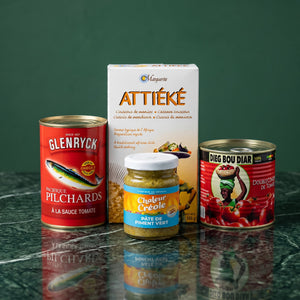
NKOSI sells the broken rice, double tomato paste and spices for this recipe, and ships them from the Paris area within 24 to 72 working hours, to mainland France (2 to 3 working days) and to ten European countries. The minimum order is 39 €: in France, delivery to a pickup point is then free, and home delivery is free from 69 €.