

Yam is an edible tuber of the genus Dioscorea, a staple of West African and Caribbean cuisine, where it is boiled, pounded into foutou or fried. It is never eaten raw and should not be confused with sweet potato, often wrongly called “yam” in the United States. This guide explains its varieties, its composition, the cooking precautions and the best ways to cook it.
What is yam? A vegetable, not a fruit
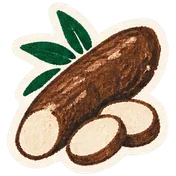
Yam is a tuber, that is, the underground part of a climbing plant of the genus Dioscorea (Dioscoreaceae family). It is therefore a starchy vegetable, not a fruit, even though its flesh is sometimes slightly sweet once cooked. Its skin is thick and brown, its flesh white, yellow or purple depending on the variety, and a tuber can weigh several kilograms.
The genus Dioscorea includes several hundred species worldwide, but only about ten are grown for food. Nigeria alone accounts for between two thirds and three quarters of world yam production, and West Africa as a whole for more than 90% of this production, according to FAO compilations. Yam also holds a strong social place there: in several regions, including south-eastern Nigeria, a new yam festival marks each harvest, and offering yams is part of certain family customs.
What are the cultivated yam varieties?
Several species are shared across African and Caribbean cuisines.
- White yam (Dioscorea rotundata): white, firm flesh, it is the most cultivated and most consumed species in West Africa, particularly for foutou and pounded yam.
- Yellow yam (Dioscorea cayenensis): close to the previous one, yellow flesh, widely present in West and Central Africa.
- Purple yam or winged yam (Dioscorea alata): also called water yam, it is the most widespread species in the world, grown in the Caribbean, the Indian Ocean and the Pacific.
- Cush-cush yam (Dioscorea trifida): a variety grown in the Caribbean and South America.
- Bitter yam (Dioscorea dumetorum): a species that contains more bitter substances, including dioscorine, and which must be rid of these substances by slicing then prolonged soaking before cooking.
Not to be confused with so-called wild yam (Dioscorea villosa), a North American species used in herbal medicine and by the pharmaceutical industry to extract a precursor for hormone synthesis: it is not cooked like a food yam.
Yam, cassava, sweet potato: what are the differences?
These three starchy foods are often confused, but they are plants from different botanical families.
| Yam | Cassava | Sweet potato | |
|---|---|---|---|
| Family and genus | Dioscoreaceae, Dioscorea | Euphorbiaceae, Manihot esculenta | Convolvulaceae, Ipomoea batatas |
| Cooked texture | dense, not very sweet, suited to pounding | fibrous, floury | tender, distinctly sweet |
| Precaution | always cooked; bitter varieties are soaked then cooked | always cooked; bitter varieties have their cyanogenic compounds removed by soaking and cooking | cooks quickly |
Another frequent confusion: in the United States, certain orange-fleshed sweet potatoes are marketed under the name “yam”, even though they have no botanical link to the true African yam, which is larger, drier and less sweet. To find out all about its cousin cassava, see our attiéké product page, the cassava semolina.
Composition of yam: what the nutritional tables say
Composition varies depending on the species, the age of the tuber and the table consulted. Here are the ranges published by the FAO (Opara compilation, 1999) for several yam species, and the reference given by the USDA nutritional table for a generic “yam” entry, always per 100 g of raw tuber.
| Nutrient | FAO, range by species | USDA, generic entry |
|---|---|---|
| Energy | 71 to 135 kcal | 118 kcal |
| Carbohydrates | 16 to 32 g | 27.9 g |
| Fibre | 0.4 to 10 g | 4.1 g |
| Protein | 1.4 to 3.5 g | 1.5 g |
| Potassium | 294 to 397 mg | 816 mg |
| Vitamin C | 4 to 18 mg | 17.1 mg |
These discrepancies, even between two official tables, show that a single, precise figure does not exist for “yam” in general: it depends on the species and the analysis method.
Cooking yam: precautions and methods
Yam is never eaten raw. According to the FAO, cultivars that contain bitter substances such as dioscorine, particularly bitter yam, are sliced then soaked for several hours in salted water before being cooked, to eliminate these compounds. The varieties commonly grown for food (white, yellow, purple yam) are, for their part, made edible and pleasant only by thorough cooking through: raw, their flesh also contains calcium oxalate crystals, which cause itching on contact with skin, as in other tubers.
- Cooked through: the tip of a knife should go through the tuber without resistance, generally after 20 to 25 minutes of boiling for chunks.
- Peeling: it is better to peel under running water or with gloves, because of the irritating crystals located under the skin.
- Damaged parts: remove blackened or mouldy areas generously before cooking.
- Boiled: peeled and cut into chunks, this is the base served with a sauce.
- Pounded into foutou: boiled then pounded in a mortar until a smooth paste is obtained, the classic accompaniment to West African sauces.
- Fried or grilled: in slices or thick chips, cooked in oil or on the barbecue.
Recipes with yam
A few recipes from the NKOSI blog for cooking yam or its cassava-based equivalent.
- Yam foutou: the step-by-step recipe for pounding boiled yam into a smooth paste, the traditional accompaniment to West African sauces.
- Cassava foufou: the same pounding method, with cassava flour instead of fresh yam.
- Traditional palm nut sauce: the palm oil sauce that classically accompanies foutou and boiled yam in West and Central Africa.
Where to find what you need to cook yam in France?
NKOSI, an African and Caribbean grocery store specialising in dry and ambient products, does not sell fresh yam. To recreate the foutou gesture at home, the shop offers foufou flours based on dried cassava, the closest dry starchy food, ready to mix into hot water:
- RACINES foufou, cassava flour for foufou, 1 kg bag.
- EXOTICA cassava foufou, cassava flour from Cameroon, 1 kg bag.
Also browse the African flours and starchy foods range. A good fresh yam, meanwhile, is chosen firm and heavy in the hand, with no soft spots, and keeps whole in a dry, dark, ventilated place for several weeks: below about 12°C, it suffers a cold shock that speeds up its deterioration, so it is better to avoid the fridge as long as it has not been cut. To go further, also see our plantain guide, the other great starchy food of foutou.