









BONMAFÉ peanut paste is made from roasted peanuts ground into a smooth paste: 97.5% peanuts, a little vegetable oil and salt, with no added sugar. It is the base of mafé, the great peanut sauce of Senegal and Mali, and of all the peanut sauces of West Africa. 500 g jar.
What is peanut paste?
Peanut paste is made by grinding shelled, roasted peanuts into a thick paste, whose natural oil can rise to the surface. The pastes sold for African cooking, such as BONMAFÉ or DAKATINE, contain about 97.5% roasted peanuts, a little salt and sometimes a vegetable oil or an emulsifier, but no added sugar: they are designed for savoury sauces, not for sweet spreads.
Peanut paste or peanut butter: what is the difference?
In food composition tables, “peanut butter” and “peanut paste” refer to the same family of products: ground roasted peanuts. The difference lies in the recipe. The most common peanut butter, North American in inspiration, often adds sugar, salt and sometimes oils or stabilisers for a smooth texture and a mild taste suited to spreading. African-style peanut paste has a short ingredient list, with no added sugar, and a more pronounced roasted peanut taste: it is stirred into a sauce, even if nothing stops you from spreading it on bread.
Mafé, the peanut paste dish
Mafé originated among the Mandinka and Bambara peoples of Mali. The name is thought to come from the Wolof “maafe”, which refers to a stew or a peanut sauce; in Mali, the dish is also called “tiga dèguè na”, peanut paste sauce, in Bambara. Before the arrival of the peanut, introduced to Senegal in the sixteenth century by Portuguese traders, Malian cooks thickened their sauces with the Bambara pea. The development of peanut farming in the nineteenth century made mafé a dish for sharing, found in Senegal, the Gambia, Guinea, Côte d'Ivoire and Burkina Faso, each one adding its own vegetables and meat: a large pot, meat or fish simmered in peanut sauce, root vegetables, and white rice to serve.
How to use peanut paste for mafé?
- Stir the jar well: the oil can rise to the surface.
- Thin the paste with a little stock or lukewarm water, bit by bit, to avoid lumps. Allow about 250 g of paste for 1 kg of meat.
- Pour it into the tomato sauce in which the meat and vegetables are simmering, then cook over low heat, stirring, until the sauce thickens.
The step-by-step recipes are on the blog: beef mafé, chicken mafé, fish mafé and traditional peanut sauce.
Which vegetables for mafé?
Root vegetables and vegetables that hold up to cooking: sweet potato, cassava, carrot, and whatever the market offers depending on the region. For a vegetarian mafé, replace the meat with these vegetables and use a vegetable stock: the peanut paste alone provides most of the texture and flavour of the sauce.
In which other dishes?
Peanut paste also binds the peanut sauce of Côte d'Ivoire and Cameroon, with chicken, smoked fish or vegetables, Cameroonian ndolé, where it softens the bitter leaves, Malian djouka with fonio, and some leaf sauces such as pondu. To compare mafé with West Indian colombo, a blog article sets out the difference between the two dishes.
Which peanut paste should you choose?
The peanut paste and mafé section brings together three pastes with no added sugar: the BONMAFÉ on this page, in a 500 g jar, designed for mafé; DAKATINE peanut paste, in a 425 g tin, the historic brand made in Strasbourg; TANTIE peanut paste, in a 500 g jar. To make it yourself, PROFRUIT raw shelled peanuts can be roasted and ground at home.
How to store it?
Before opening, at room temperature, away from light. Once the jar is open, close it tightly: the label indicates storage in a dry place, at room temperature, and consumption preferably within 3 months of opening. It is normal for a thin layer of oil to rise to the surface: stir before each use.
What to pair it with?
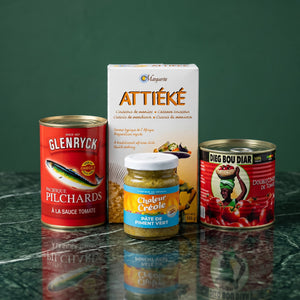
For a complete mafé: DIEG BOU DIAR double concentrated tomato paste, ORCHIDÉE twice-broken rice and a touch of soumbara, or our Senegalese mafé kit, which brings everything together. To discover the three pastes: the peanut paste discovery kit.
Product information
- Brand: BONMAFÉ (Racines SA)
- Contents: 500 g jar
- Ingredients: roasted peanuts 97.5%, hydrogenated vegetable oil 2%, salt 0.5%
- Allergens: peanuts
- Nutritional values per 100 g: energy 2588 kJ (625 kcal), fat 51.4 g of which saturates 6 g, carbohydrates 9.3 g of which sugars 5.9 g, fibre 8.4 g, protein 27.2 g, salt 0.5 g
- Storage: in a dry place, at room temperature; best consumed within 3 months of opening
Precautions
This product is made from peanuts, one of the fourteen allergens that must be declared in the European Union: it is not suitable for people who are allergic to peanuts, and neither is the mafé made with it.