


Chikwangue NUMBER ONE, also called kwanga, is a paste of fermented cassava that is already cooked, wrapped in leaves and vacuum-packed. You only need to reheat it before serving it in slices with a sauce. 500 g piece, made in Cameroon.
What is chikwangue?
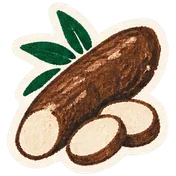
A compact cassava loaf, emblematic of the Congo basin. The cassava is soaked, pounded into a paste, wrapped in leaves and then cooked for a long time: fermentation gives it its characteristic taste and smell. Originating in the Democratic Republic of the Congo, where it is called kwanga in Lingala, chikwangue is widespread in Congo-Brazzaville and Gabon. This one arrives already cooked: all you have to do is reheat it.
Chikwangue, kwanga, bobolo, miondo: what are the differences?
Kwanga is the Lingala name, chikwangue its French form: it is the same product. In Cameroon, similar preparations are called bobolo among the Beti and miondo, in thinner sticks, among the Douala. All of them are based on the same principle: a fermented cassava paste cooked in leaves. Foufou is different, it is a flour you mix with water yourself, and attiéké is a steamed semolina.
How to reheat chikwangue?
The label says to reheat it for 4 minutes, in the oven, in the microwave or in a water bath. Then remove the leaves and cut it into slices or sticks. It is eaten hot, with no further cooking.
How is chikwangue eaten?
Cut into slices or sticks, hot, with a sauce: pondu, or saka saka, made with NUMBER ONE dried cassava leaves, moambe chicken, salted or smoked fish, such as smoked catfish fillet. It is the accompaniment to meals in the Congo basin, like rice or foufou elsewhere. The homemade chikwangue recipe is on the blog, for those who want to make it themselves from cassava.
What does chikwangue taste like?
A dense, firm and elastic paste, with a tangy, slightly fermented taste and no salt: it is eaten with a well-seasoned sauce, whose flavour it absorbs. Its smell, strong when the pack is opened, comes from the fermentation of the cassava: this is normal, and it is what its fans look for.
How to store it?
Unopened, vacuum-packed, until the best before date printed on the pack. Once opened, keep the rest in the fridge, well wrapped, and eat it quickly.
What to pair it with?
For a complete Congolese meal: dried cassava leaves, MAMA FUTA palm oil and smoked catfish. For large gatherings, the pack of chikwangue pieces. Products from the Congo are gathered in the Congolese grocery section.
Product information
- Brand: NUMBER ONE; made in Cameroon for Tai Yat Distribution (Garges-lès-Gonesse)
- Net weight: 500 g, vacuum-packed
- Ingredient: cooked cassava paste, 100% cassava
- Allergens: none of the 14 regulated allergens; cassava does not contain gluten
- Nutritional values per 100 g (label): energy 159 kcal, carbohydrates 38.06 g, protein 1.4 g, fat 0.2 g, fibre 1.8 g, water 59.7%
- Storage: best before date printed on the pack; once opened, keep the rest in the fridge, well wrapped, and eat it quickly