







Foufou, fufu and foutou keep coming up in African recipes, and many readers think it is a single word spelled three different ways. In reality, these three terms refer to the same family of starchy pastes, pounded or mixed, but with origins, ingredients and methods that change markedly from one country to another.
A word from Twi, among the Akan people of Ghana
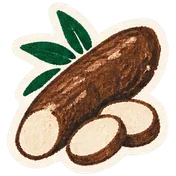
The word fufu comes from Twi, the language of the Akan (Ashanti, Akuapem, Akyem, Fanti) of present-day Ghana, where it refers to the action of pounding and mixing; according to some analyses, it could also evoke the white colour of the dish. Originally, the paste was prepared with yam, plantain or taro pounded in a wooden mortar with a pestle. Cassava only arrived in the sixteenth century, brought from Brazil by Portuguese traders, before gradually establishing itself as the most common base across a large part of West and Central Africa.
Fufu, between Ghana and Nigeria
In Ghana, pounded fufu remains the reference version: cassava and plantain, or taro, boiled then pounded together in a wooden mortar until an elastic, sticky paste is obtained. In Nigeria, the preparation is different: peeled cassava is soaked for several days to ferment, before being pressed then cooked, giving a denser, distinctly tangy paste, sometimes called akpu among the Igbo. Both versions are eaten with the fingers, in small balls dipped in a sauce such as egusi or ogbono soup.
Foutou, the pounded speciality of Côte d'Ivoire
In Côte d'Ivoire, it is not called foufou but foutou. The dish combines plantain, ripe or green, with cassava or yam, boiled then pounded together in a mortar until a smooth, very elastic texture is reached. Its origins go back to the culinary practices of the Akan and Baoulé peoples of Côte d'Ivoire; foutou is mainly eaten in the centre and east of the country, with sauce graine, made from palm nuts, or a light sauce with smoked fish.
Foufou, the French spelling for Central Africa and the Antilles
Foufou is the spelling used in French, notably in Cameroon, the Democratic Republic of the Congo, the Republic of the Congo, Gabon and the French Antilles. The method also changes: rather than pounding fresh roots, a dried cassava flour is most often mixed straight into boiling water, stirring until a smooth paste is obtained. It is the quickest and most practical preparation for the diaspora in France.
Comparison table
| Criterion | Fufu (Ghana, Nigeria) | Foutou (Côte d'Ivoire) | Foufou (French) |
|---|---|---|---|
| Origin | Ghana and Nigeria | Côte d'Ivoire | Cameroon, Congo, DRC, Antilles |
| Base | Cassava, plantain, taro | Plantain and cassava or yam | Dried cassava flour |
| Method | Pounded in a mortar, or fermented cassava then pressed in Nigeria | Pounded in a mortar | Mixed into boiling water |
| Texture | Elastic and sticky, or dense and tangy in Nigeria | Very elastic, almost mouldable | Smooth and soft |
| Typical sauce | Egusi, ogbono soup | Sauce graine, light fish sauce | Peanut sauce, leaf sauce, ndolé |
Which base to choose depending on the recipe
- Ghanaian or Nigerian cuisine: fufu, with egusi or ogbono.
- Ivorian cuisine: foutou, with sauce graine.
- Cameroonian, Congolese or Antillean cuisine: foufou, with ndolé or a leaf sauce.
Where to find the ingredients in France
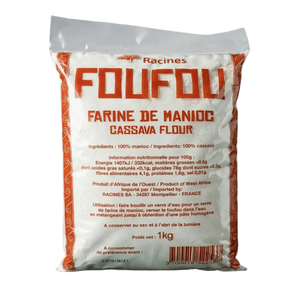
NKOSI offers two cassava flours to prepare a mixed foufou the French way: foufou RACINES and foufou de manioc EXOTICA, from Cameroon. Akpi-Kablè foufou pepper completes the accompanying sauce. The step-by-step recipe is on the blog: cassava foufou.
Frequently asked questions
Do foufou and fufu taste the same?
No. Pounded Ghanaian fufu remains fairly neutral and elastic, fermented Nigerian fufu is distinctly more tangy, and foufou mixed from flour, common in France, gives a soft, smooth paste.
Do you need a mortar to make a real foutou?
Traditionally, yes: pounding in a mortar gives it its characteristic elastic texture. At home, a powerful food processor or a pestle gives a similar result, starting from boiled cassava or yam.
Where can you find the ingredients for foufou in France?
NKOSI sells cassava flours to prepare a mixed foufou and ships them from the Paris area within 24 to 72 working hours, to mainland France (2 to 3 working days) and to ten European countries. The minimum order is 39 €: in France, delivery to a pickup point is then free, and home delivery is free from 69 €.
To learn more about cassava and its derivatives, see our complete cassava guide.