







Traditional African cuisine has less to do with a list of dishes by country, already covered elsewhere on this blog, than with a set of techniques passed down in family kitchens: pounding, fermentation, cooking covered over low heat, and the meal eaten from a single shared dish. Here are four of them, with recipes on the site where you can find them.
Pounding, a central gesture
In many West African and Central African kitchens, the mortar and pestle turn boiled tubers, yam, cassava or plantain, into a smooth, even paste: this is foutou, fufu or foufou. The gesture, repeated with regularity and a certain force, is passed down in family kitchens, from generation to generation. See the recipe for cassava foufou and for pounded yam.
Fermentation, for preservation and for flavour
For centuries, cassava tubers have been fermented before being eaten: peeled, washed and grated, cassava ferments for two to three days, which reduces its cyanogenic compound content and improves its keeping quality. This fermentation gives West African gari, dried then roasted, or Central African chikwangue, bobolo and miondo, wrapped and then steamed in banana leaves. See the recipes for chikwangue, bobolo and miondo.
Cooking covered over low heat, between leaves and clay pots
Wrapped in a banana leaf and then set over steam, or simmered for a long time in a clay pot (the canari, in West Africa), the dish cooks covered, with no large quantity of added water or fat. This is the method for fish wrapped and steamed in Central Africa, or for tajine in North Africa, where the conical lid traps the steam and slowly tenderises meat and vegetables. The porosity of the clay absorbs moisture and releases heat gradually. See the recipe for pondu (saka saka), prepared in Central Africa, and for tajine.
The shared meal, a single dish for the whole household
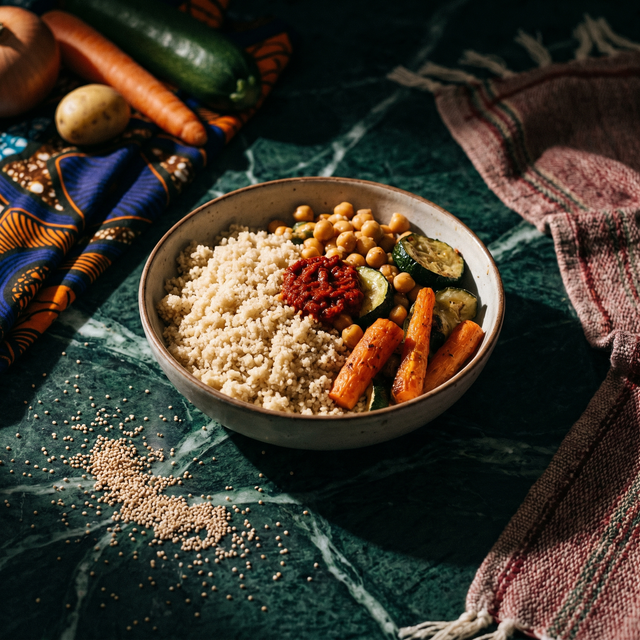
In Mali and Senegal in particular, the meal is often served in one large shared dish placed in the centre, around which the family gathers to eat together, everyone taking from their portion of the dish. This single dish, rice and sauce, millet and sauce, or millet couscous with vegetables, structures the daily meal in several West African countries and remains a moment of gathering, especially during celebrations. See the ten dishes of Mali and those of Senegal.
To go further
This article focuses on techniques and customs rather than an inventory of dishes by country: for an overview of cuisines by region, head to the guide to African food; for ingredients, the ingredients guide or our selection of the 10 essential ingredients.