
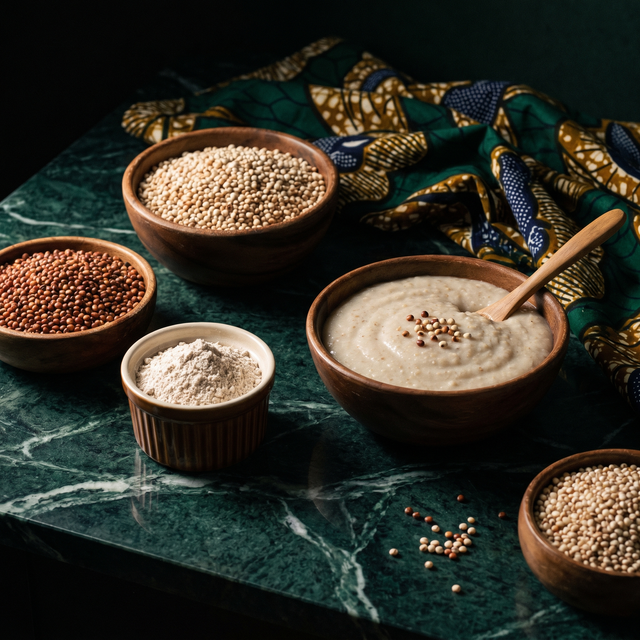
Sorghum is a cereal that originated in north-eastern Africa and has been grown for several millennia. It spread across the whole African continent and beyond, and remains a staple food in the Sahel. Little known in Europe, it is cooked as whole grain, as semolina or as flour. This article presents its origins, its composition according to the Anses Ciqual table, how to cook it and a few traditional recipes.
Origins and cultivation of sorghum in Africa
Sorghum was domesticated in north-eastern Africa, in the region stretching from Ethiopia to Sudan according to the FAO, and then spread across the whole African continent and beyond. It grows in dry environments where other cereals do poorly, which explains its place in the Sahel diet: tho in Burkina Faso, injera in Ethiopia, boule in Mali, porridges in Senegal. It is also used as flour and for traditional beer (dolo).
Composition of sorghum
The Anses Ciqual table (food item “Sorghum, whole grain, raw”, code 9360) gives, per 100 grams, 349 kilocalories, 10.6 grams of protein, 65.4 grams of carbohydrates, 3.5 grams of fat and 6.7 grams of dietary fibre. The grain also provides minerals, shown below as a share of the nutrient reference values (NRVs) of Regulation (EU) No 1169/2011. These values apply to the raw grain: after cooking in water they are lower per 100 grams, because the grain absorbs water.
| Mineral | Per 100 g of raw grain | Share of NRVs |
|---|---|---|
| Magnesium | 165 mg | 44% |
| Manganese | 1.61 mg | 81% |
| Phosphorus | 289 mg | 41% |
| Potassium | 363 mg | 18% |
| Iron | 3.36 mg | 24% |
| Zinc | 1.67 mg | 17% |
Sorghum is not one of the cereals that contain gluten (wheat, rye, barley, oats, spelt, kamut). If you need to avoid gluten, check the product label: a naturally gluten-free grain can be contaminated at harvest, in transport or during processing. The “gluten-free” claim is only permitted if the product contains no more than 20 mg of gluten per kilo, under Implementing Regulation (EU) No 828/2014.
How do you cook sorghum?
Sorghum can be cooked in several forms:
- Whole grain: soak for 8 hours, then cook for 50 min in water or stock, like brown rice. Great in warm salads, soups and as a side dish
- Cracked sorghum: cook for 25 min, a texture close to bulgur
- Sorghum flour: porridges, flatbreads, baking
- Popped sorghum: grains that pop like popcorn, as a snack
Traditional recipes made with sorghum
Sorghum is at the heart of many African recipes:
- Burkinabé tho: a thick paste of sorghum flour, served with sauces
- Malian boule: a sweet porridge for breakfast
- Ethiopian injera: a tangy flatbread, the base of the meal (often made with teff, but sorghum is also used)
- Sorghum porridge: for breakfast, with milk, sugar and cinnamon
Key points
- Sorghum is not one of the cereals that contain gluten: in case of intolerance, check for the “gluten-free” claim on the label
- Per 100 g of raw whole grain: 10.6 g of protein and 6.7 g of fibre (Anses Ciqual table)
- It is cooked in salads, porridges, baking and side dishes
- NKOSI does not sell sorghum for the moment, but offers fonio and millet-based products
Sorghum, millet, quinoa and rice: comparison per 100 g of raw grain
| Grain | Protein /100g | Fibre /100g | Ciqual code |
|---|---|---|---|
| Sorghum | 10.6 g | 6.7 g | 9360 |
| Millet | 11 g | 8.5 g | 9330 |
| Quinoa | 13.2 g | 7 g | 9340 |
| White rice | 7.04 g | 1.05 g | 9100 |
Source of the values above: Anses Ciqual table (ciqual.anses.fr).
Where can you find sorghum in France?
NKOSI does not sell sorghum for the moment. In the African cereals and seeds section, you will find related West African cereals: NUMBER ONE pre-cooked fonio, TANTIE Soungouf millet flour or KEBA millet thiéré. NKOSI ships them from the Paris region within 24 to 72 working hours, to mainland France (2 to 3 working days) and to ten European countries. The minimum order is €39: in France, pick-up point delivery is then free, and home delivery is free from €69.
Conclusion
Sorghum is an ancient African cereal, cooked as whole grain, semolina or flour, and naturally gluten-free. To go further, read the article on fonio, another West African cereal, or browse the full NKOSI grocery range.
Frequently asked questions
Is sorghum gluten-free?
Sorghum is not one of the cereals that contain gluten. If you have coeliac disease or are gluten intolerant, still check the label: a grain can be contaminated at harvest, in transport or during processing. The “gluten-free” claim means a maximum of 20 mg of gluten per kilo (Implementing Regulation (EU) No 828/2014). Ask your doctor for advice if in doubt.
How do you cook whole-grain sorghum?
Soak the grains for 8 hours, then cook for 50 minutes in 3 times their volume of salted water. Cracked sorghum cooks in 25 minutes without soaking.
Where can I buy sorghum in France?
NKOSI does not sell sorghum for the moment. The online grocery offers other West African cereals, such as pre-cooked fonio and millet-based products, on nkosiagro.com.