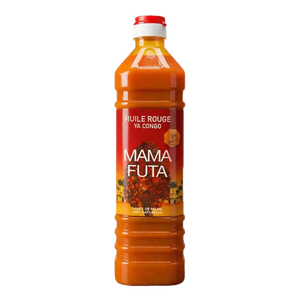


Futa is the common name, in France, for red palm oil, popularized by the MAMA FUTA brand. Unrefined, orange-red in colour, it serves as a base fat in several cuisines of Central and West Africa.
What is futa?
The word futa comes from the name of the MAMA FUTA brand, which became a common name in African grocery stores in France for red palm oil. This oil is extracted from the pulp of the fruit of the oil palm (Elaeis guineensis), unrefined: it keeps its natural orange-red colour, its strong aroma and taste, unlike refined palm oil, which is bleached and deodorized and used by the food industry.
Where does red palm oil come from?
The oil palm is native to the tropical forest belt of West and Central Africa, from Cameroon to Ivory Coast, taking in Ghana, Liberia, Nigeria, Sierra Leone and Togo, as far as Angola. Its processing into edible oil has been practised there for millennia: charred kernels have been found on sites dated to around 2000 years before our era, and flasks of palm oil were placed as offerings in tombs of ancient Egypt. The oil palm has also spread widely in Indonesia and Malaysia, which have become the world's leading producers.
What is red palm oil made of?
Like most vegetable oils, it contains about half saturated fatty acids, led by palmitic acid, and half unsaturated fatty acids, mostly oleic acid. Its orange-red colour comes from its high content of carotenoids, pigments also found in carrots or tomatoes, which largely disappear during refining. Per 100 grams, it provides about 3700 kilojoules (900 kilocalories) and 100 grams of fat, of which 49.5 grams are saturated fatty acids.
How to use red palm oil in cooking?
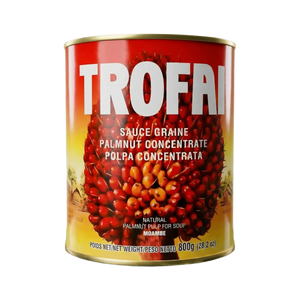
In the pondu and saka saka of the two Congos, cassava leaves simmer in the red oil with onion, garlic and smoked fish. In moambe and sauce graine, it provides colour and taste when palm nut pulp is not available. Cameroonian ndolé and Ghanaian red red also rely on it. A few tablespoons are enough: its taste is strong.
Why does red palm oil solidify?
In a cool kitchen, it clouds and then partly solidifies: this is normal, it naturally contains fats that harden at room temperature. Simply immerse the bottle for a few minutes in hot water for it to become liquid again, with no change in taste.
Red palm oil and refined palm oil
Red oil is the crude oil, pressed from the pulp of the fruit: it keeps its colour, its aroma and its carotenoids. Refined palm oil, used by the food industry, is bleached and deodorized: it loses its colour and much of its carotenoids. It is red oil that gives Central African dishes their colour and character.
Palm oil and sustainability
The cultivation of the oil palm has grown strongly in Indonesia and Malaysia over recent decades, with a documented impact on deforestation and biodiversity in these regions. A certification has existed since 2004, run by the Roundtable on Sustainable Palm Oil (RSPO), but several environmental organizations, including Greenpeace, consider that it has not managed to halt deforestation or biodiversity loss.
Frequently asked questions about futa
What can replace futa in a recipe?
Nothing truly reproduces its taste. Failing that, a neutral oil with a little tomato paste or paprika added will give a similar colour, but not the characteristic aroma of red palm oil.
Are futa and foutou the same thing?
No. Futa is an oil, drawn from the fruit of the oil palm. Foutou, or foufou, is a pounded paste made from cassava or plantain, served as a side dish. The two words sound alike, but one is poured and the other is eaten by hand.
Where to find red palm oil in France?
NKOSI sells MAMA FUTA red palm oil in a 75 cl bottle and ships it from the Paris area within 24 to 72 working hours, to mainland France (2 to 3 working days) and to ten European countries. The minimum order is 39 €: in France, delivery to a pickup point is then free, and home delivery is free from 69 €.
To put together a complete meal around red palm oil, the palm oil and sauce graine range and the recipes on the NKOSI blog, Congolese moambe and pondu, complete this article.