




Safou, also called atanga or African plum, is the fruit of the safou tree, a tree from Central Africa. Its flesh is never eaten raw: it is always prepared with heat, in water or over embers, before accompanying corn, cassava or plantain. NKOSI does not sell this fresh fruit; this guide presents its identity, its place in Cameroonian, Gabonese and Congolese cooking, and its preparation.
What is safou?
Safou is the fruit of the safou tree (Dacryodes edulis), a tree native to the forests of Central Africa. It goes by several names depending on the country: safou in Cameroon and Congo, atanga in Gabon, nsafu or bush butter in English. It is an oblong fruit, the size of a large olive, with smooth skin that turns from dark blue to almost black purple at maturity. Its flesh, pale green and dense, surrounds a central pit.
The main producing countries are Cameroon, Congo, the Democratic Republic of the Congo, Gabon and Nigeria. The harvest is seasonal.
Safou in the cooking of Cameroon, Gabon and Congo
In Cameroonian, Gabonese and Congolese markets, safou is often sold already cooked, prepared by street vendors. It traditionally accompanies boiled or grilled corn, a pairing so common that it serves as a street meal in several regions. For the Central African diaspora in France, the fruit remains linked to family meals and gatherings.
How is safou prepared?
Safou is practically never eaten raw: its flesh is then firm and astringent. Two traditional methods make it tender:
- Dipped for a few minutes in hot water, until the flesh softens.
- Placed on embers or put in the oven, which gives it a grilled note.
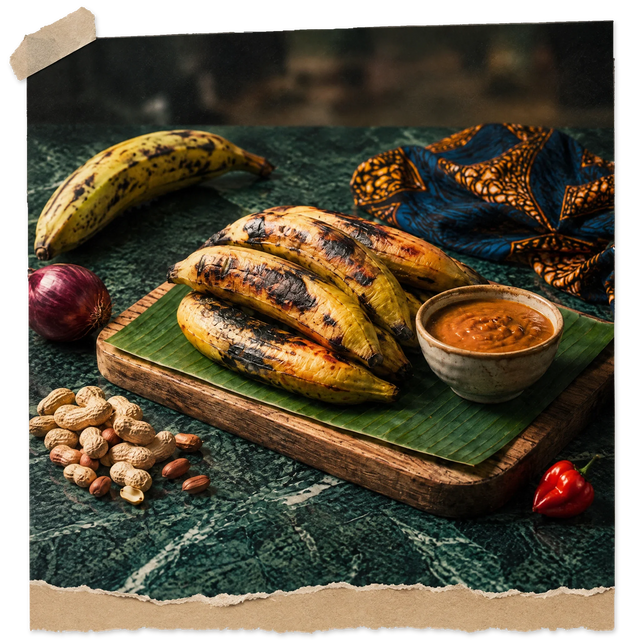
Once cooked, the fruit is peeled to recover the flesh around the pit. The most common accompaniment is boiled or grilled corn; some add cassava or plantain.
Composition of safou pulp
Laboratory analyses put the fat content of the fresh pulp between 48 and 59 g per 100 g, with a majority of unsaturated fatty acids (oleic acid and linoleic acid), around 2.7 to 6.3 g of fiber and 18 to 20 g of protein per 100 g. These values vary according to the variety, ripeness and analysis method.
Status of safou in France and the European Union
Fresh safou remains a niche product, imported in small quantities and sold mainly by specialty grocery stores, particularly in Paris, during its short season. Its status under the European novel food regulation, which governs the placing on the market of a food not significantly consumed in the Union before 1997, could not be confirmed for this article: the European novel food catalogue is an interactive research database, not accessible through an ordinary search. NKOSI does not sell this fresh fruit and does not promote it.
To go further
Other Central African ingredients and dishes are presented on the NKOSI blog: Cameroonian cuisine, Gabonese cuisine and plantain, a traditional accompaniment to safou.
Frequently asked questions about safou
Is safou eaten raw?
No, almost never. Raw, it is firm and astringent. It is always prepared with heat, in hot water or over embers, which makes its flesh tender.
What is the difference between safou and atanga?
None: these are two names for the same fruit. Atanga is the common term in Gabon, while safou and African plum are more general.
Is safou sold in France?
Fresh safou remains hard to find outside its season and outside grocery stores specializing in Central African products. NKOSI does not sell it: the store offers dry, ambient products, to be kept at room temperature.


![Cola Nuts from the brand [Brand Name]: 250g/500g/1kg.](http://www.nkosiagro.com/cdn/shop/files/cola-rouge-nkosi-agro.webp?v=1774103054&width=300)