
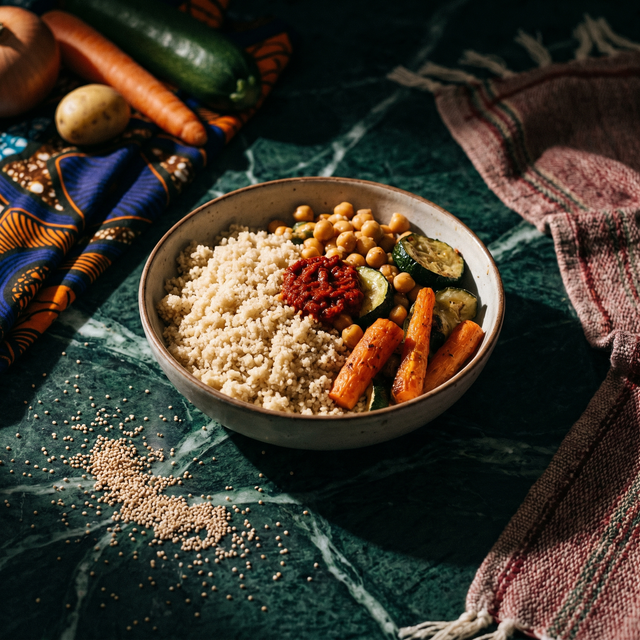


Sankhal is a semolina of crushed millet grains, also called gné-gné in Senegal. A single ingredient: millet. It is cooked as a porridge for lakh and breakfasts, or steamed like couscous to go with a saucy dish. 500 g bag.
What is sankhal?
Senegalese millet products look alike on the shelf, but each has its own use. Sankhal is crushed millet grains, coarser than thiéré, which is rolled into fine pellets for couscous. Thiakry, with larger granules, is reserved for the curdled-milk dessert. Arraw is used for porridges with small balls. Sankhal TANTIE is a reference product from the Haudecœur house. Its taste is that of millet: cereal-like, mild, a little rustic.
How to prepare it?
- As a porridge: pour the sankhal in a steady stream into slightly salted boiling water and cook for about ten minutes, stirring, until the porridge thickens.
- As lakh: serve this thick porridge with sweetened curdled milk, flavoured with vanilla or orange blossom.
- As a savoury couscous: moisten the semolina and steam it, fluffing it between two steamings, then serve with a sauce.
It is a dry product, kept in the cupboard.
What to pair it with?
For lakh: NIDO powdered milk, NESTLÉ sweetened condensed milk and SAMIA orange blossom water. The other millets of Senegalese cuisine: KEBA thiéré millet, KEBA thiakri millet and KEBA arraw millet. The recipe for Senegalese lakh is on the blog. The whole section: Senegalese cuisine.
Product information
- Brand: TANTIE (Haudecœur)
- Contents: 500 g bag
- Ingredient: 100% millet
- Allergens: none of the 14 allergens that must be declared, by nature. The bag does not carry a “gluten-free” certification.
- Origin: Senegal
- Storage: in a dry place, at room temperature, bag well closed
- Average nutritional values per 100 g: energy 1,520 kJ (360 kcal), fat 4.2 g of which saturates 0.7 g, carbohydrates 64 g of which sugars 0 g, fibre 8.5 g, protein 12 g