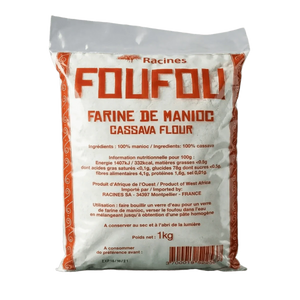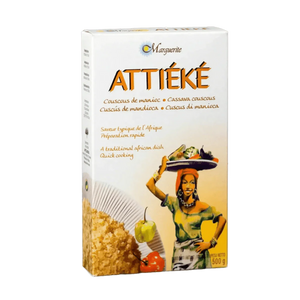


On Ivorian tables, placali holds a place that few dishes can claim. This fermented cassava paste, supple and slightly tangy, accompanies the most generous sauces of southern Ivory Coast cuisine. It is shaped into a ball, dipped into the sauce, and every mouthful tells of a cuisine of sharing, long-simmered, made to bring people together.
If you have ever tasted attiéké or foutou, placali is their close cousin, more melting, more fermented. Made from soaked then pounded cassava, it requires patience and real know-how. Here is everything you need to know to understand this iconic dish, succeed with it at home, and find the right ingredients in France.
What is placali?
Placali is a food paste made from fermented cassava, originating in Ivory Coast. The cassava is first peeled, soaked in water for several days, then grated or pounded until it forms a smooth paste. This paste is then cooked over low heat while stirring vigorously, which gives it its characteristic texture: at once compact, elastic and melting in the mouth.
Its slightly sour flavour comes from fermentation, the essential step that sets it apart from other cassava preparations. Unlike gari or dried cassava flour, placali is eaten fresh, the same day it is made. It is never eaten alone: it serves as a support for rich sauces that are the whole point of it. To better place placali among the other cassava derivatives, our cassava, attiéké and foufou guide details each preparation.
Origin and tradition of placali
Placali has its roots in southern Ivory Coast, particularly among the Akan communities and in the lagoon regions around Abidjan. Cassava, introduced to West Africa several centuries ago, became a dietary pillar thanks to its ability to grow even on poor soils and to keep once processed.
Traditionally, preparing placali is collective work. The women pound the cassava in large wooden mortars, a rhythmic gesture passed down from generation to generation. The dish appears at family meals, ceremonies and major occasions, where it symbolises abundance and hospitality. To serve placali to a guest is to offer them what Ivorian cooking has that is most generous.
Today, placali remains a strong identity marker of Ivorian cuisine. It is found in the maquis of Abidjan as in the kitchens of the diaspora, where it recalls the homeland and the flavours of childhood.
How to prepare and enjoy placali
Home preparation takes time but remains accessible. Here are the main steps:
- Peel the fresh cassava and soak it in water for two to three days to start fermentation.
- Grate or pound the soaked cassava until you get a fine, homogeneous paste.
- Gradually pour this paste into a pan of simmering water, stirring constantly with a sturdy spatula.
- Keep working the paste over low heat for fifteen to twenty minutes, until it becomes smooth, glossy and well bound.
- Shape balls with a damp spoon and serve immediately.
Placali is eaten with the fingers or with a spoon, accompanied by a well-seasoned sauce. Palm nut sauce (sauce graine), made from palm-nut pulp, brings it a red, fragrant creaminess that works wonders. Okra sauce, stringier and slightly viscous, is the other great classic: its slippery quality perfectly suits the texture of placali. It is also enjoyed with peanut sauce or a light smoked-fish sauce.
The gesture is to detach a piece of paste, form a little hollow with the fingertips, then dip it generously into the sauce before swallowing without chewing. It is a convivial way of eating, that invites you to take your time around the shared dish.
Where to find cassava and ingredients in France
Succeeding with a good placali starts with quality cassava. In France, fresh cassava is found in African and West Indian grocers, as well as at some markets. For those who don't have a specialist shop nearby, ordering online remains the simplest solution to receive authentic products at home.
At NKOSI, we select ingredients of Ivorian cuisine delivered throughout France and Europe: cassava and its derivatives, palm nut for the sauce graine, dried okra, smoked fish, traditional spices and condiments. Everything you need to recreate the flavours of home without leaving your kitchen.
If you are a beginner, know that fermented cassava flour or ready-to-cook placali powder greatly simplify the preparation: just dilute and cook them, without the soaking step. A good entry point before tackling the traditional fresh-cassava version.
Frequently asked questions
What is the difference between placali and foutou?
Placali is made from fermented cassava, which gives it a slightly tangy taste and a more melting texture. Foutou, on the other hand, often mixes pounded plantain and yam, without fermentation, for a denser, more neutral result in the mouth.
Does placali keep for long?
Placali is best enjoyed the same day, as it loses its suppleness when cooling. You can keep it for a day in the fridge and gently reheat it by steaming, but its texture will be better freshly prepared.
What sauce do you eat placali with?
The most popular accompaniments are palm nut sauce (sauce graine), made from palm nut, and okra sauce, slightly stringy. Peanut sauce and smoked-fish sauces also suit this dish very well.
Can you make placali without fresh cassava?
Yes. There is fermented cassava flour or placali powder preparations that avoid the soaking. You dilute them in water and cook while stirring, for a result close to the traditional recipe in much less time.